


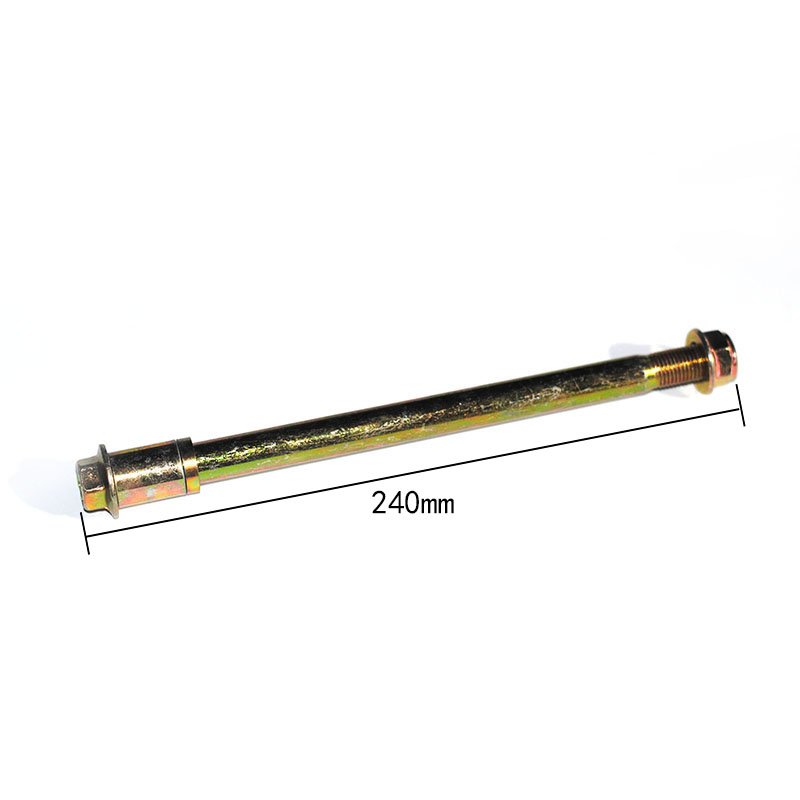
In the seemingly simple yet complex mechanical structure of three-wheeled vehicles, the 302 front axle is like a silently operating “heart”, playing a decisive role in the vehicle’s steering operation and driving stability. Although it is often overlooked, once there are problems with it, the performance and safety of the entire vehicle will be severely affected. Today, let’s step into the world of the 302 front axle of three-wheeled vehicles and uncover its mysterious veil.
Structural Analysis: Precise Structure Achieves Excellent Performance
Axle Body: The Foundation of Load-Bearing and Transmission
The axle body of the 302 front axle of three-wheeled vehicles is the core load-bearing part of the entire component. It is usually made of high-strength and high-quality steel through precise forging and fine processing. Its thickness, length, and overall shape are accurately planned according to the actual design requirements and load-bearing capacity of the three-wheeled vehicle. The diameter of the axle body is generally within a specific range to ensure that it has sufficient strength to bear the weight of the front part of the vehicle and various impact forces from the road surface during driving. In terms of material, these steels not only have excellent hardness, which can resist wear and deformation, but also have a certain degree of toughness to prevent fracture under the action of sudden strong external forces. The surface treatment of the axle body is also extremely particular. Through multiple processes such as grinding and polishing, its surface is made smooth, effectively reducing the friction coefficient with other components, reducing energy consumption, and extending its service life.
Steering Knuckle: The Key Hub for Flexible Steering
The steering knuckle is like the “joint” of the front axle and is the key to achieving flexible steering of the three-wheeled vehicle. It has a unique fork-shaped structure, which is ingeniously designed and sturdy and durable. There are two coaxial holes precisely arranged at the upper and lower fork parts of the steering knuckle for installing the kingpin. This design enables the steering knuckle to swing smoothly around the kingpin. The journal of the steering knuckle is used to firmly install the wheel, ensuring that the wheel can accurately change its direction under the drive of the steering knuckle. In actual driving, when the driver turns the handlebar, the steering force is transmitted to the steering knuckle through a series of transmission components. The steering knuckle will then rotate a corresponding angle around the kingpin, and then drive the wheel to achieve the steering action. The material of the steering knuckle is usually similar to that of the axle body, also using high-strength steel to withstand the huge torque and impact force generated during the steering process. At the same time, the internal structural design of the steering knuckle also fully considers the principles of mechanics. Through reasonable shape and size optimization, the fatigue resistance of the steering knuckle is improved, and the reliability and stability of the steering operation are guaranteed.
Kingpin and Bearings: The Guarantee for Smooth Operation
As a key component connecting the front axle and the steering knuckle, the kingpin is like a “bridge” and plays a crucial articulation role. Its main function is to enable the steering knuckle to swing freely around it, thus achieving the flexible steering of the wheels. The kingpin is generally made of high-hardness and high-strength alloy steel, and its surface undergoes a special heat treatment process to further improve its wear resistance and corrosion resistance. In the middle part of the kingpin, there is a carefully designed groove. During installation, the kingpin is firmly fixed to the knuckle-shaped parts at both ends of the front axle through the close cooperation between the kingpin fixing bolt and the groove, ensuring that the kingpin will not loosen or displace during the vehicle’s driving process and providing a solid support for the stable swing of the steering knuckle.
Bearings are also indispensable in the operation of the 302 front axle of three-wheeled vehicles. They are mainly installed between the steering knuckle and the axle body, as well as between the wheel and the journal of the steering knuckle. The function of the bearings is to reduce the friction between components, making the rotation of the wheels smoother. At the same time, they can effectively bear the vertical load, horizontal driving force and braking force, as well as the lateral friction force generated during the vehicle’s driving. Common types of bearings include tapered roller bearings, deep groove ball bearings, etc. These bearings all have the characteristics of high precision, high load-bearing capacity, and long service life. When selecting bearings, it is necessary to comprehensively consider factors such as the actual operating conditions of the three-wheeled vehicle, the magnitude of the load, and the rotational speed to ensure that the selected bearings can meet the performance requirements of the vehicle.
In-depth Analysis of the Working Principle: The Coordinated Operation of Steering and Support
Steering Principle: The Realization of Precise Control
When the driver turns the handlebar of the three-wheeled vehicle, the steering operation is officially initiated. The rotation of the handlebar is transmitted to the steering gear through the steering column. The steering gear amplifies and changes the direction of the relatively small steering force applied by the driver and then transmits it to the tie rod. The tie rod is connected to the steering knuckle. When the steering force acts on the steering knuckle, since the steering knuckle is articulated with the front axle through the kingpin, the steering knuckle will swing around the kingpin. As the steering knuckle swings, the wheel installed on the journal of the steering knuckle also rotates accordingly, thus achieving the steering of the vehicle. In this process, the axle body of the 302 front axle plays a stable supporting role, ensuring that the steering knuckle can remain stable during the swing and will not shake or deviate. At the same time, the cooperation between the kingpin and the bearings makes the swing of the steering knuckle smoother, reduces the steering resistance, and improves the sensitivity and accuracy of steering. The entire steering process is like a carefully choreographed dance. Each component works together to accurately execute the driver’s steering commands, providing flexible and reliable steering control for the vehicle’s driving.
Support Principle: The Cornerstone of Stable Driving
During the driving process of the three-wheeled vehicle, the 302 front axle shoulders the important mission of supporting the weight of the front part of the vehicle. The weight of the front part of the vehicle includes the weight of the front of the vehicle, the driver’s seat, some goods, and the front suspension system, etc. These weights are evenly distributed to the two front wheels through the front axle. As the main load-bearing component, the axle body of the front axle can effectively bear these weights and transmit them to the ground by virtue of its solid structure and high-strength material. At the same time, the front axle also needs to bear various reaction forces from the road surface, such as the bump impact force in the vertical direction, the driving force and braking force in the horizontal direction, and the lateral force generated when the vehicle turns. When dealing with these complex forces, the front axle closely cooperates with components such as the steering knuckle, kingpin, and bearings to jointly play a role. The steering knuckle and the kingpin can reasonably distribute the forces from the road surface to each part of the front axle to avoid excessive local stress; while the bearings reduce the friction and wear between components through their own rolling, ensuring that the front axle can still operate smoothly under the action of various forces, providing a solid foundation for the stable driving of the vehicle. Whether driving at high speed on a flat road or moving forward with difficulty on a rugged mountain road, the 302 front axle always sticks to its post and provides escort for the stable driving of the vehicle.
Common Faults and Maintenance: Timely Maintenance to Ensure Vehicle Performance
Wear and Deformation: The Hidden Danger of Performance Degradation
During long-term use, due to the complex and changeable driving environment of the three-wheeled vehicle and frequent steering operations, the 302 front axle will inevitably experience wear and deformation. The wear is mainly concentrated in the parts where the axle body contacts the bearings, the mating surface between the steering knuckle and the kingpin, and the installation place of the wheel and the journal of the steering knuckle. Long-term friction will cause scratches, pits, or even peeling on the surface of these parts, reducing the fitting accuracy between components, resulting in abnormal noises and vibrations. When the wear reaches a certain extent, it may also lead to more serious problems such as bearing damage and steering knuckle loosening.
Deformation is usually caused by reasons such as vehicle overloading, severe impacts during driving, or long-term driving on poor road conditions. Once the axle body of the front axle is deformed, it will directly affect the driving stability and steering performance of the vehicle. For example, the bending of the axle body may cause uneven wear of the wheels, greatly shortening the service life of the tires; the deformation of the steering knuckle may lead to inflexible steering or even the dangerous situation of steering out of control. Wear and deformation are like “time bombs” hidden inside the vehicle. If they are not discovered and dealt with in a timely manner, they will seriously affect the performance and safety of the vehicle, bringing great potential risks to the driver.
Maintenance and Replacement: The Key to Restoring Performance
When faults such as wear or deformation are found in the 302 front axle, maintenance or replacement must be carried out in a timely manner. For slightly worn components, some repair measures can be taken to restore their performance. For example, for slight scratches and wear on the surface of the axle body, methods such as grinding and polishing can be used for treatment to remove the surface defects, and then appropriate lubrication can be carried out to reduce friction. For the wear of the mating surface between the steering knuckle and the kingpin, it can be solved by adjusting the clearance or replacing the severely worn bushings. When carrying out these maintenance operations, professional tools and equipment are required, and the operations must be carried out strictly in accordance with the maintenance process requirements to ensure the maintenance quality.
If the components are severely worn or have been deformed and their performance cannot be restored through repair, new components need to be replaced in a timely manner. When replacing components, products with exactly the same model and specification as the original components should be selected to ensure their compatibility and adaptability. At the same time, attention should be paid to selecting products with reliable quality to avoid using inferior parts, so as not to affect the performance and safety of the vehicle. The process of replacing components requires certain professional skills and experience, and it is recommended to be operated by professional maintenance personnel. After replacing the components, the maintenance personnel also need to conduct a comprehensive debugging and inspection of the vehicle to ensure that the front axle and related components are installed correctly and the steering and driving performance of the vehicle is restored to normal.
The 302 front axle of three-wheeled vehicles, this seemingly insignificant component, plays a pivotal role in the operation of three-wheeled vehicles. Understanding its structure, working principle, as well as common faults and maintenance methods is of great significance for every three-wheeled vehicle driver and maintenance personnel. Only by giving the 302 front axle sufficient attention and maintenance can we ensure that the vehicle is always in good operating condition and provide a safe and reliable guarantee for our travel and transportation. Let’s attach importance to this “core pillar” of the vehicle and let it continue to escort our three-wheeled vehicle journey.