


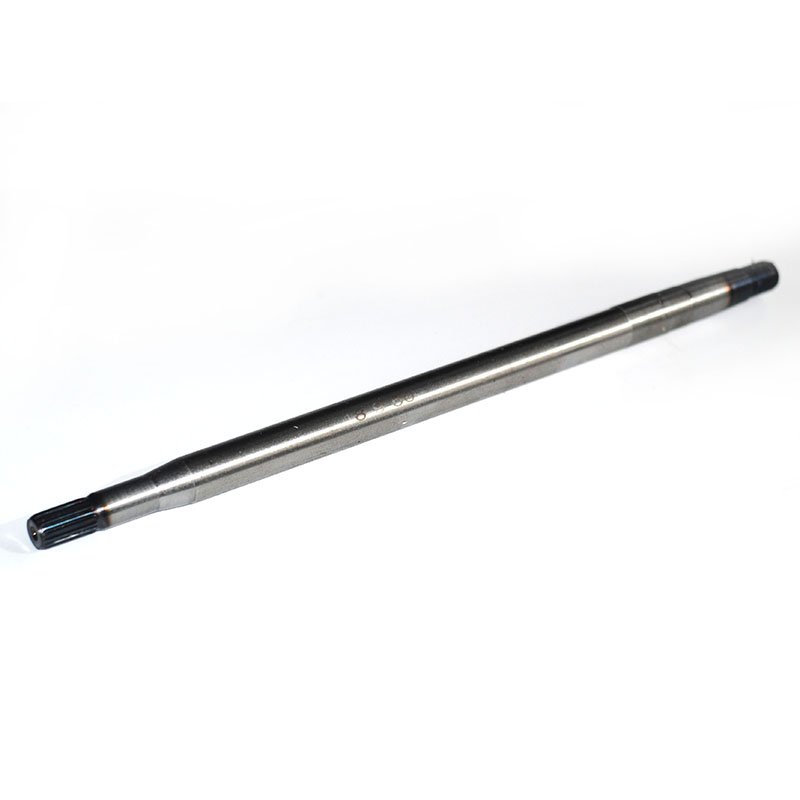
In the complex and sophisticated mechanical structure of three-wheeled vehicles, there is a small component that seems insignificant at first glance but plays a pivotal role in the vehicle’s operation. It is the 205 bearing of the rear axle half shaft. Despite its small size, it shoulders the heavy responsibility of ensuring the smooth driving of the vehicle and the effective transmission of power, and can be regarded as the “unsung hero” of the stable operation of the vehicle. Today, let’s delve into the mysteries of this “low-key hero” together.
In-depth Analysis of the Structure: Small Size, Big Design
Inner Ring, Outer Ring and Rollers: The Core Combination for Coordinated Operation
The 205 bearing is mainly composed of three key components: the inner ring, the outer ring, and the rollers. The inner ring is like a closely fitting “intimate sheath” that is tightly sleeved on the half shaft, integrating with the half shaft and rotating synchronously with the rotation of the half shaft. Its inner diameter is precisely designed to perfectly fit the half shaft, ensuring a firm connection between the two, without the slightest looseness during the vehicle’s driving process, providing a reliable guarantee for the operation of the half shaft, just like putting on a tailor-made and sturdy armor for the half shaft.
The outer ring is installed inside the hub of the rear axle and remains relatively fixed, just like a solid fortress, providing stable and reliable support for the entire bearing. It cooperates with the inner ring to jointly construct an ideal “track” for the smooth rolling of the rollers. On this track, the rollers are neatly arranged, usually with a quantity of about 15 to 20. These rollers are carefully manufactured from high-quality bearing steel, with extremely high hardness and a surface as smooth as a mirror, which can minimize the frictional resistance. When the vehicle is driving, the rollers roll merrily between the inner ring and the outer ring, like agile dancers, skillfully converting the rotational motion transmitted from the half shaft into a smooth and stable rotation, greatly reducing the energy loss during the power transmission process, ensuring the efficient operation of the entire bearing system, and providing stable power support for the vehicle’s driving.
Cage: The “Commander” for the Ordered Operation of the Rollers
In addition to the inner ring, the outer ring, and the rollers, there is another indispensable and important role – the cage. The cage is like a rigorous and responsible “commander”. Its existence is of great significance, and its main responsibility is to ensure that the rollers always maintain an even spacing during the rolling process, avoiding collisions or jams between the rollers. The cage is generally made by stamping thin steel plates, with a uniquely designed shape. It can not only lightly wrap the rollers, giving the rollers enough space to move, but also be closely connected to the inner ring or the outer ring through a special structure and rotate synchronously with the rotation of the bearing. During the vehicle’s driving process, especially under complex working conditions such as high-speed driving or frequent gear shifting, the importance of the cage will become prominent. It can enable the rollers to perform their respective duties and work in an orderly manner at their respective “posts”, effectively ensuring the stability and reliability of the bearing, and effectively preventing the bearing from being damaged due to the disorderly movement of the rollers, which in turn affects the normal driving of the vehicle, providing a solid guarantee for the stable operation of the vehicle.
In-depth Interpretation of the Working Principle: The Key Link for Power Transmission and Balance
Power Transmission: The Efficient Relay from the Engine to the Wheels
When the three-wheeled vehicle starts and the engine begins to rumble and operate, the power is like a surging river, continuously transmitted to the rear axle half shaft through a series of components such as the clutch and the gearbox. At this time, the 205 bearing makes a brilliant appearance and becomes a key link in the power transmission process. The half shaft begins to rotate under the action of the powerful torque transmitted from the engine. Since the inner ring is closely connected to the half shaft, the inner ring also rotates synchronously. The rotation of the inner ring is like starting a precision machine, driving the rollers to roll rapidly between the inner ring and the outer ring. And the outer ring is fixed on the hub, and with the rolling of the rollers, the hub can also rotate smoothly. In this way, the power of the engine is accurately transmitted to the wheels through the half shaft and the 205 bearing, just like a baton in a relay race, driving the vehicle to move forward steadily. This process is like a wonderful relay race. As a key “relay runner”, the 205 bearing, with its precise power transmission ability, ensures that the vehicle can drive smoothly and efficiently converts the power of the engine into the driving force of the vehicle. If the vehicle is compared to a vibrant human body, and the engine is the heart that provides power, then the 205 bearing is the key “vein” connecting the heart and the limbs, ensuring the smooth transmission of power and enabling the vehicle to gallop freely.
Support and Balance: The Stabilizer Ensuring the Smooth Driving of the Vehicle
The 205 bearing not only plays an important role in power transmission but also undertakes the arduous task of supporting the wheels and maintaining the balance of the vehicle. During the vehicle’s driving process, the wheels will be subjected to various complex forces from the road surface, including the gravitational force in the vertical direction, which is like an invisible pressure constantly pressing on the wheels; the driving force and braking force in the horizontal direction, which determine the acceleration, deceleration, and stopping of the vehicle; and the frictional force in the lateral direction, which affects the stability of the vehicle when turning. The outer ring of the 205 bearing, through its close cooperation with the hub, is like a solid shield that can effectively bear these external forces and evenly distribute them to the entire rear axle structure, avoiding damage caused by excessive local stress. At the same time, the rolling of the rollers between the inner ring and the outer ring enables the wheels to remain stable during rotation, greatly reducing the vibrations and bumps caused by the uneven road surface. This is just like installing a high-performance “balancer” for the vehicle, allowing the vehicle to always maintain a stable posture during the driving process. Whether on a flat and wide highway or a rough rural road, it can make the driver feel comfortable and safe, providing a reliable guarantee for the safe driving of the vehicle.
Common Faults and Maintenance: Quick Repair and Back to Smooth Driving
Wear and Damage: Small Problems Leading to Big Crises
During long-term use, due to the complex and changeable driving environment of the vehicle, the 205 bearing will inevitably experience wear and damage. The wear is mainly caused by the continuous friction between the rollers and the inner ring and outer ring, as well as the huge pressure borne by the bearing when the vehicle is driving. As the usage time increases, when the wear reaches a certain extent, defects such as scratches and pits will gradually appear on the surface of the rollers. These flaws are like “time bombs” hidden inside the bearing, which will cause abnormal noises during the operation of the bearing, and the driver will also clearly feel the vibrations when the vehicle is driving. If the severely worn bearing is continued to be used at this time, it is like walking on thin ice, and more serious problems may occur, such as the rupture of the rollers, the fracture of the inner ring or the outer ring, etc. Once these situations occur, the bearing will instantly lose its normal working ability, the vehicle may suddenly lose power, and even the wheels may fall off, seriously endangering driving safety. This is just like the joints of a person’s body. If they are overused for a long time and lack maintenance, after the joints are severely worn, it will not only affect movement but also may lead to more serious health problems, bringing great safety hazards to the vehicle and the driver.
Maintenance and Replacement: Timely “Treatment” to Restore the Vehicle’s Vitality
When a fault is found in the 205 bearing, immediate action should be taken, and it should be repaired or replaced in a timely manner. For a slightly worn bearing, it can be repaired by means of cleaning, lubrication, etc. First, the bearing needs to be carefully removed from the vehicle. This step requires certain professional skills and tools to ensure that no damage is caused to other components during the operation. Then, use a special cleaning agent to carefully clean the inner ring, outer ring, rollers, and cage of the bearing. The cleaning agent can penetrate into every tiny corner of the bearing, removing the oil stains, impurities, and wear particles on the surface, restoring the bearing to cleanliness. After cleaning, apply an appropriate amount of high-quality lubricating grease to each component of the bearing. The lubricating grease is like injecting a burst of vitality into the bearing, which can effectively reduce friction and wear and extend the service life of the bearing. When reinstalling the bearing, it is necessary to ensure that the installation position is accurate and that the cooperation between each component is tight. Otherwise, it may affect the normal operation of the bearing.
If the bearing is severely worn or already damaged, then a new bearing needs to be replaced. When selecting a new bearing, special attention should be paid to choosing a product with the same model as the original bearing and reliable quality. Bearings of different models may have differences in dimensions, performance, etc. If the wrong model is selected, it may lead to installation failure or affect the normal operation of the vehicle. The process of replacing the bearing requires certain professional skills and tools, and it is recommended to be operated by professional maintenance personnel. Professional maintenance personnel have rich experience and professional technology, and they can accurately complete the disassembly and installation work to ensure that the replaced bearing can work normally and provide a strong guarantee for the safe driving of the vehicle.
The 205 bearing of the rear axle half shaft of three-wheeled vehicles, although just a small component, plays a crucial role in the operation of three-wheeled vehicles. Understanding its structure, working principle, as well as common faults and maintenance methods can help us better maintain and service the vehicle, ensuring that the vehicle is always in good operating condition and providing a reliable guarantee for our travel and transportation. Let’s attach importance to this “small component” together, let it continue to “escort” our three-wheeled vehicles, and accompany us to drive safely and smoothly on every journey.